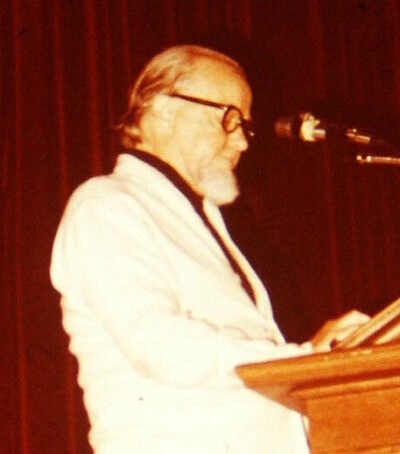
Francis Schaeffer
American pastor and philosopher who founded L'Abri Fellowship and made the case that the Bible provides a comprehensive, coherent worldview addressing all of reality — truth, art, culture, and history.
Key Works
The God Who Is There(1968)
A foundational work arguing that Christianity provides the only intellectually satisfying answers to the deepest questions of philosophy, morality, and meaning.
Genesis in Space and Time(1972)
An exploration of Genesis 1-11 as real history in real space and time, showing why the opening chapters of the Bible matter for everything that follows.
How Should We Then Live?(1976)
A sweeping survey of Western thought and culture from Rome to the present, showing how the biblical worldview shaped civilization and what happens when it is abandoned.
He Is There and He Is Not Silent(1972)
A philosophical argument for the existence of the personal God of the Bible, addressing metaphysics, morality, and epistemology.
Francis Schaeffer was an American pastor, philosopher, and cultural critic who insisted that the Bible is not merely a religious book but a comprehensive worldview that speaks to every area of life — philosophy, art, science, politics, and personal relationships. From his mountain community of L'Abri in Switzerland, he influenced a generation of Christians to take both their faith and their culture seriously.
His Story
Schaeffer grew up in a working-class family in Germantown, Pennsylvania. As a teenager, he began reading the Bible to refute it and instead became convinced of its truth. After seminary training, he served as a pastor in the United States before moving to Switzerland in 1948 as a missionary. A crisis of faith in the early 1950s led him to question whether Christianity was merely a set of correct doctrines or a living reality that transforms everything. He concluded it was both.
In 1955, Schaeffer and his wife Edith founded L'Abri ("the shelter" in French), a community in the Swiss Alps where seekers, students, and skeptics could come to discuss the deepest questions of life. Hundreds of young people — many disillusioned with both institutional Christianity and secular culture — found their way to L'Abri. Schaeffer would sit for hours in conversation, taking every question seriously and always directing the discussion back to the God who is there.
His Contribution to the Big Picture of Scripture
Schaeffer's distinctive contribution was showing that the Bible provides a total worldview — a framework for understanding all of reality. He wrote: "Christianity is not a series of truths in the plural, but rather truth spelled with a capital 'T.' Truth about total reality, not just about religious things." He insisted that the Bible speaks not only to questions of personal salvation but to the nature of reality, the basis of morality, the meaning of art, and the direction of history.
In Genesis in Space and Time, Schaeffer made the case that the opening chapters of the Bible are foundational: "If the beginning is not right, the whole structure is wrong. If the beginning is right, there is a basis for the answers." He traced how the biblical narrative of creation, fall, and redemption provides the only adequate framework for understanding human dignity, moral absolutes, and the possibility of meaning.
How Should We Then Live? surveyed the rise and decline of Western civilization through the lens of Scripture, arguing that when cultures abandon the biblical worldview, they inevitably drift toward despair: "The basic problem of the Christians in this country in the last eighty years or so... is that they have seen things in bits and pieces instead of totals." Schaeffer called Christians to see the Bible as a unified whole that speaks to the whole of life.
Why Read Schaeffer Today?
Schaeffer was ahead of his time in many ways. His warnings about the drift of Western culture away from biblical foundations have proven remarkably prescient. For Christians who want to engage thoughtfully with philosophy, art, science, and culture, Schaeffer provides a model of how to do so without retreating into pietistic isolation or capitulating to secular assumptions. His writing is passionate, accessible, and unafraid to tackle the hardest questions. As he wrote, "Biblical Christianity is Truth concerning total reality — and the intellectual holding of that total Truth and then living in the light of that Truth."