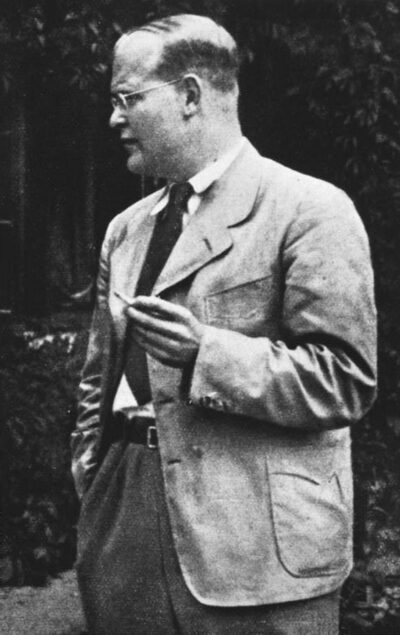
Dietrich Bonhoeffer
German pastor, theologian, and anti-Nazi dissident whose writings on radical discipleship and costly grace continue to challenge and inspire Christians worldwide.
Key Works
The Cost of Discipleship(1937)
A prophetic call to authentic Christian obedience, famous for its distinction between 'cheap grace' and 'costly grace.'
Life Together(1939)
A brief, powerful reflection on Christian community drawn from Bonhoeffer's experience leading an underground seminary.
Letters and Papers from Prison(1951)
Posthumously published letters and writings from his imprisonment by the Nazis, exploring faith in a world 'come of age.'
Ethics(1949)
His unfinished magnum opus, published posthumously, wrestling with how Christians should live responsibly in a broken world.
Dietrich Bonhoeffer is one of the most compelling Christian figures of the twentieth century. A brilliant German theologian who could have sat out the horrors of Nazism in the safety of an American professorship, he chose instead to return to Germany, resist Hitler, and ultimately lay down his life. His writings — especially The Cost of Discipleship and Life Together — remain among the most powerful calls to authentic, Scripture-rooted Christian living ever penned.
His Story
Bonhoeffer was born into an upper-class Berlin family and showed extraordinary intellectual gifts from a young age. He completed his doctorate in theology at the University of Berlin at just 21. After study at Union Theological Seminary in New York — where he was deeply influenced by the African American church in Harlem — he returned to Germany just as Adolf Hitler was rising to power.
Bonhoeffer became a leader of the Confessing Church, which opposed the Nazi regime's attempt to co-opt German Christianity. He ran an illegal underground seminary at Finkenwalde, training pastors for faithful ministry in a time of profound moral crisis. His experience there produced Life Together, his classic work on Christian community. Eventually, he was drawn into the conspiracy to assassinate Hitler, was arrested, and was executed at Flossenburg concentration camp on April 9, 1945 — just two weeks before the camp was liberated.
His Contribution to the Big Picture of Scripture
Bonhoeffer's great theme was the cost of following Jesus — a theme drawn directly from Christ's words in the Gospels. His most famous passage confronts the church's tendency to domesticate the gospel: "Cheap grace is the preaching of forgiveness without requiring repentance, baptism without church discipline, communion without confession... Cheap grace is grace without discipleship, grace without the cross, grace without Jesus Christ, living and incarnate."
Against this, he set "costly grace": "Such grace is costly because it calls us to follow, and it is grace because it calls us to follow Jesus Christ. It is costly because it costs a man his life, and it is grace because it gives a man the only true life." Bonhoeffer read the Sermon on the Mount (Matthew 5-7) not as an impossible ideal but as a concrete call to obedience — "only he who believes is obedient, and only he who is obedient believes."
His prison writings wrestle with how to live faithfully before God in a world that seems to manage without God. He wrote from his cell: "God lets himself be pushed out of the world on to the cross. He is weak and powerless in the world, and that is precisely the way, the only way, in which he is with us and helps us."
Why Read Bonhoeffer Today?
Bonhoeffer's life and death give his words an authority that few writers possess. He did not merely theorize about discipleship — he lived it to the end. In an age of comfortable Christianity, his challenge remains urgent: are we following Jesus or merely admiring him from a distance? His short book Life Together is one of the finest things ever written about Christian community, and The Cost of Discipleship remains essential reading for anyone who takes the Sermon on the Mount seriously. As he wrote to his students, "When Christ calls a man, he bids him come and die."