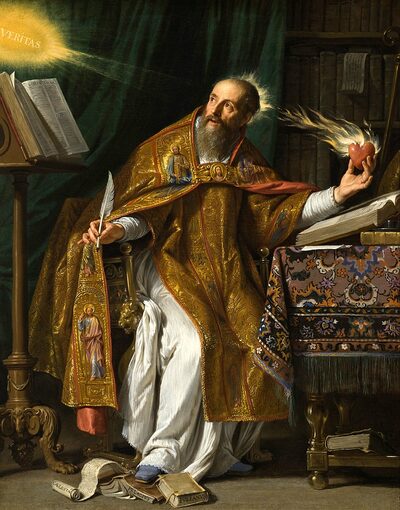
Augustine of Hippo
Bishop of Hippo, theologian, and Doctor of the Church whose writings on grace, sin, and the nature of God shaped Western Christianity for over 1,500 years.
Key Works
Confessions(397-400 AD)
Autobiographical work tracing his spiritual journey from sin to faith — one of the first great autobiographies in Western literature.
City of God(413-426 AD)
A monumental work defending Christianity against pagan criticism after the fall of Rome, laying out a Christian philosophy of history.
On the Trinity(400-416 AD)
His systematic exploration of the doctrine of the Trinity and the image of God in humanity.
Expositions on the Psalms(392-418 AD)
Commentaries on all 150 Psalms, showing how they point to Christ and the life of faith.
Augustine of Hippo is one of the most influential thinkers in the history of Christianity. Born in North Africa to a pagan father and a devout Christian mother (Monica), Augustine's life story is one of dramatic conversion — from a brilliant but restless young man pursuing pleasure and philosophy to one of the church's greatest theologians.
His Story
As a young man, Augustine was drawn to Manichaeism, then to Neoplatonism, and finally — through the prayers of his mother and the preaching of Ambrose of Milan — to Christianity. His baptism in 387 AD marked the beginning of a life devoted to understanding and defending the faith.
His Confessions is not merely autobiography but a sustained prayer to God, reflecting on memory, time, sin, and grace. Its opening line has echoed through the centuries: "You have made us for yourself, O Lord, and our hearts are restless until they rest in you."
His Legacy
Augustine's influence is almost impossible to overstate. His writings shaped:
- The doctrine of grace — that salvation comes from God's initiative, not human effort
- The understanding of original sin — that humanity's brokenness runs deeper than individual choice
- The philosophy of history — that earthly cities rise and fall, but the City of God endures
- The practice of introspection — that knowing God and knowing yourself are inseparably linked
Both Catholic and Protestant traditions claim Augustine as a foundational thinker. Martin Luther was an Augustinian monk; John Calvin quoted Augustine more than any other church father.
Why Read Augustine Today?
Augustine speaks to anyone who has wrestled with doubt, struggled with habitual sin, or felt the tension between intellectual seeking and spiritual surrender. His honesty about his own failures — and his wonder at God's persistent grace — makes his writing remarkably accessible across the centuries.