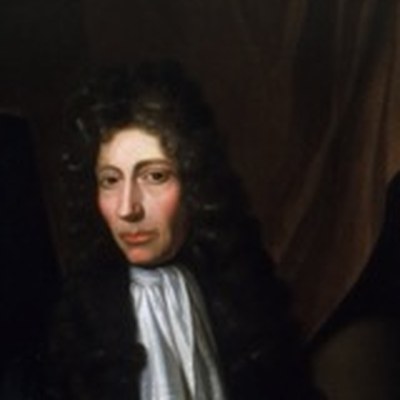
Robert Boyle
Anglo-Irish founder of modern chemistry whose deep Anglican faith led him to learn the biblical languages, fund Bible translations, and endow lectures defending Christianity.
Key Works
The Sceptical Chymist(1661)
The book that challenged alchemy's old theories and helped turn chemistry into a genuine experimental science.
The Christian Virtuoso(1690)
His argument that the experimental study of nature, far from undermining faith, actually disposes a person to be a better Christian.
Boyle Lectures(1691)
A lecture series he endowed in his will to defend the Christian faith against unbelief, launched in 1692 and still delivered today.
Robert Boyle is often called the father of modern chemistry — the man behind Boyle's law and a founding figure of the Royal Society. He was also one of the most openly devout scientists of his age: an Anglican layman who studied Hebrew and Greek to read the Bible in its original languages, paid for Scripture translations out of his own pocket, and left money in his will to fund lectures defending the Christian faith.
His Story
Boyle was born at Lismore Castle in Ireland, the fourteenth child of the wealthy Earl of Cork. As a teenager traveling in Europe, he was caught in a violent thunderstorm in Geneva and, terrified, resolved to live wholly for God — a commitment he kept for the rest of his life. Settling eventually in Oxford and then London, he devoted himself to careful experiments on air, vacuum, and the nature of matter, publishing The Sceptical Chymist in 1661 and the gas law that bears his name.
Boyle never married and gave away much of his fortune. He funded a translation of the Bible into Irish Gaelic, supported missionary translations abroad, and served as governor of a society for spreading the gospel in New England. Though friends urged him toward ordination, he declined, believing he could serve God better as a layman — his witness for Christ would carry more weight, he judged, coming from a scientist with nothing to gain. When he died in 1691, his will endowed the Boyle Lectures for the defense of Christianity.
His Legacy
Boyle helped shape both modern science and the Christian engagement with it:
- His insistence on careful experiment and published results helped establish chemistry as a true science
- Boyle's law, relating the pressure and volume of gases, is still taught to every science student
- His generosity put the Bible into new languages, from Irish Gaelic to mission fields overseas
- The Boyle Lectures he endowed have brought leading thinkers to defend the faith for over three centuries
Why Read Boyle Today?
Boyle believed the more deeply we study creation, the more reasons we find to worship its Creator — and he backed that conviction with a lifetime of meticulous lab work. The Christian Virtuoso remains a thoughtful case that experimental science and sincere faith strengthen each other. For anyone tempted to think modern science was built in opposition to Christianity, Boyle's life tells a very different story.