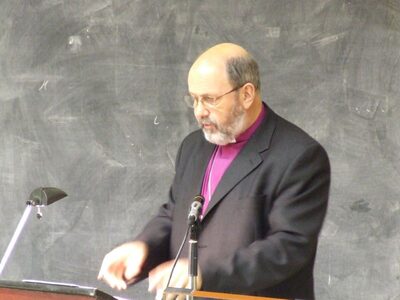
N.T. Wright
British New Testament scholar, historian, and Anglican bishop whose work on the grand narrative of Scripture has reshaped how a generation reads the Bible.
Key Works
The New Testament and the People of God(1992)
The first volume of his landmark series, laying out the Jewish worldview and narrative framework that shaped the earliest Christians.
Simply Christian(2006)
A compelling introduction to the Christian faith, tracing the deep human longings for justice, beauty, relationship, and spirituality.
Surprised by Hope(2008)
A groundbreaking book on resurrection and new creation, challenging popular misconceptions about heaven and the afterlife.
Scripture and the Authority of God(2005)
A fresh account of what it means to call the Bible authoritative, grounded in the Bible's own story.
The Resurrection of the Son of God(2003)
An exhaustive historical argument for the bodily resurrection of Jesus as the best explanation of the evidence.
N.T. Wright is arguably the most influential New Testament scholar of the last fifty years. A prolific author, former Bishop of Durham, and Research Professor at the University of St Andrews, Wright has devoted his career to helping both scholars and ordinary readers understand the Bible not as a collection of isolated proof-texts but as a single sweeping drama — a story that begins with creation and culminates in God's restoration of all things through Jesus Christ.
His Story
Nicholas Thomas Wright was born in Morpeth, Northumberland, England. From his student days at Oxford, he was captivated by the question of how the earliest Christians understood themselves within the larger story of Israel. While much modern scholarship had treated the New Testament as a set of theological abstractions, Wright insisted on reading it historically — as the writings of first-century Jews who believed that Israel's God had acted decisively in Jesus of Nazareth to fulfill the promises of the Hebrew Scriptures.
Wright has described his life's work as "trying to think about the whole of the biblical narrative and how it holds together." His massive multi-volume series Christian Origins and the Question of God represents perhaps the most ambitious scholarly project in New Testament studies since the Reformation. Yet he is equally at home writing accessible books for lay readers, insisting that rigorous scholarship and vibrant faith belong together.
His Contribution to the Big Picture of Scripture
Wright's central insight is that the Bible tells a coherent five-act drama: creation, fall, Israel, Jesus, and the church — with a final act of new creation yet to come. He has written: "The Bible is not a collection of timeless truths or moral lessons. It is the story of God's rescue operation for the whole of creation." This narrative framework has transformed how countless readers approach both Old and New Testaments. His emphasis on the continuity between Israel's story and the gospel of Jesus has helped bridge the gap between the Testaments that many readers find bewildering.
His work on the resurrection — particularly The Resurrection of the Son of God — is a landmark of historical scholarship, making the case that "the bodily resurrection of Jesus is the only explanation that accounts for the rise of early Christianity." His vision of Christian hope, articulated in Surprised by Hope, recovers the biblical promise that God's plan is not to rescue souls out of the world but to renew the whole creation: "What God did for Jesus at Easter, He will do for the whole cosmos."
Why Read Wright Today?
Wright is essential reading for anyone who wants to see how the whole Bible fits together. He takes the Old Testament seriously on its own terms, reads Jesus within the story of Israel, and shows how Paul and the other apostles understood themselves as living in the next chapter of that same story. For readers who have struggled with a fragmented Bible — bits of moral advice here, theological doctrine there — Wright offers a compelling alternative: a unified narrative that makes sense of the whole. As he has said, "The point of the Bible is not that we can go to heaven when we die, but that the kingdom of heaven comes to earth."