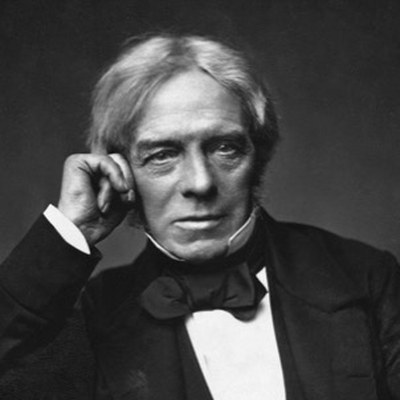
Michael Faraday
Self-taught scientist who discovered electromagnetic induction and invented the electric motor and generator, while serving humbly as an elder in a small Christian church.
Key Works
Experimental Researches in Electricity(1839-1855)
His collected papers on electricity and magnetism, including the discovery of electromagnetic induction — the principle behind every power station on earth.
The Chemical History of a Candle(1861)
His famous Christmas lectures for children, using a single candle to unfold the wonders of chemistry and physics in plain language.
Michael Faraday was a blacksmith's son with almost no formal education who became one of the greatest experimental scientists in history. The electric motor, the generator, and the very idea of electromagnetic fields all trace back to his laboratory at the Royal Institution in London. Through it all, he remained a quietly devout Christian, serving for decades as a member and elder of the small Sandemanian church.
His Story
Faraday grew up poor in London and was apprenticed to a bookbinder at fourteen. He educated himself by reading the books that passed through the shop, especially anything on science. After attending lectures by the famous chemist Humphry Davy, Faraday sent him a carefully bound copy of his lecture notes — and was hired as a laboratory assistant.
From that humble start came a torrent of discoveries: electromagnetic rotation in 1821 (the principle of the electric motor), electromagnetic induction in 1831 (the principle of the generator), the laws of electrolysis, and the concept of the field that would transform physics. He also founded the beloved Christmas lectures for children, which continue to this day.
Faraday's faith was not a footnote to his life. He belonged to the Sandemanians, a small church devoted to simple, New Testament Christianity, and served it faithfully as a deacon and elder. He saw no conflict between his Bible and his laboratory — he believed the natural world was God's handiwork, and studying it was a way of reading what God had made.
His Legacy
Faraday shaped both modern science and the picture of what a Christian scientist can be:
- His discoveries of induction and electromagnetic rotation made electric power and motors possible
- His field concept laid the groundwork for James Clerk Maxwell's equations and all of modern physics
- He declined a knighthood and twice refused the presidency of the Royal Society, preferring to remain plain "Mr. Faraday"
- He declined the honor of burial in Westminster Abbey, choosing a simple grave in keeping with his church's convictions
Why Read Faraday Today?
Faraday shows that brilliance and humility can live in the same person. He reached the top of the scientific world without wealth, connections, or a university degree, and he turned down its highest honors to stay faithful to a small, unfashionable church. The Chemical History of a Candle is still a delight to read — clear, curious, and full of wonder at the ordinary world. For anyone tempted to think faith and science are enemies, Faraday's life is a standing counterexample.