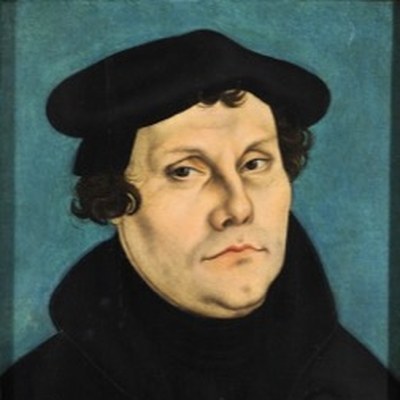
Martin Luther
German monk, professor, and Reformer whose Ninety-five Theses sparked the Protestant Reformation and whose German Bible put Scripture into the hands of ordinary people.
Key Works
The Ninety-five Theses(1517)
The list of debate points against the sale of indulgences that Luther posted in Wittenberg, igniting the Reformation.
The Bondage of the Will(1525)
His response to Erasmus, arguing that salvation rests entirely on God's grace rather than human willpower — the book Luther considered his best.
Luther's German Bible(1522/1534)
His translation of the Scriptures into everyday German — New Testament in 1522, the complete Bible in 1534 — which shaped both German faith and the German language.
Small Catechism(1529)
A brief, warm summary of the Ten Commandments, the Creed, and the Lord's Prayer, written so parents could teach the faith at home.
Martin Luther was an Augustinian monk and Bible professor whose protest against the sale of indulgences in 1517 grew into the Protestant Reformation. His rediscovery of the biblical teaching that sinners are justified by faith alone, through grace alone, reshaped the church and the history of the Western world.
His Story
Luther was born in Eisleben, Germany, and was headed for a career in law when a terrifying thunderstorm drove him to vow to become a monk. As a monk he was tormented by the question of how a sinful man could stand before a holy God — until, studying Paul's letter to the Romans, he came to see that the righteousness God requires is the righteousness God freely gives in Christ, received by faith.
In 1517 he published his Ninety-five Theses against the sale of indulgences. Summoned before the emperor at the Diet of Worms in 1521 and ordered to recant his writings, he refused, saying his conscience was captive to the Word of God. Hidden away afterward in the Wartburg Castle, he translated the New Testament into German in a matter of months. He later married Katharina von Bora, a former nun, and their lively household became a model of Protestant family life.
His Legacy
Luther's influence on the church is hard to overstate:
- He recovered the gospel of justification by faith alone, the doctrine on which he said the church stands or falls
- His German Bible let ordinary people read Scripture for themselves and set the pattern for translations across Europe
- His catechisms and hymns — including "A Mighty Fortress Is Our God" — taught the faith to generations of families
- He was also a flawed man whose later writings against the Jews were ugly and wrong, a sober reminder that God works through sinners
Why Read Luther Today?
Luther wrote with an honesty, humor, and force that still leap off the page five centuries later. He knew spiritual despair from the inside, and his answer was always the same: look away from yourself and look to Christ. For anyone who struggles to believe that God could really accept them, Luther remains one of the most bracing and comforting voices in church history.