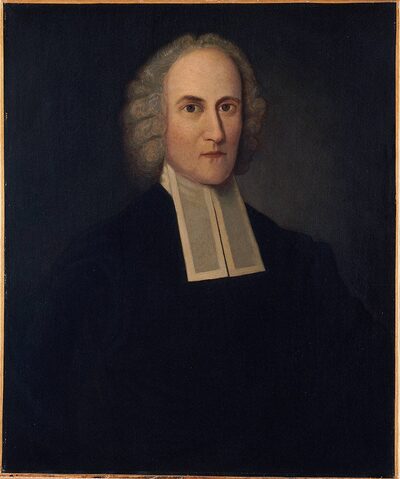
Jonathan Edwards
America's greatest theologian-philosopher, who wove together rigorous intellect and passionate spirituality to trace the entire Bible as one grand narrative of God's redemptive work.
Key Works
A History of the Work of Redemption(1774)
A sweeping narrative theology tracing God's work of salvation from the fall of Adam to the end of the world — one of the first attempts to read all of Scripture as a single redemptive storyline.
Religious Affections(1746)
A careful analysis of the nature of true religion, distinguishing genuine spiritual experience from its counterfeits through the lens of Scripture.
The End for Which God Created the World(1765)
A profound meditation on God's ultimate purpose in creation — that God created the world for the display and communication of His own glory.
Freedom of the Will(1754)
A rigorous philosophical defense of the compatibility of God's sovereignty with human responsibility, widely regarded as a masterwork of philosophical theology.
Jonathan Edwards was America's most brilliant theologian and philosopher — a man who combined the intellectual rigor of the Enlightenment with the fiery passion of the Great Awakening. Best known in popular imagination for his sermon "Sinners in the Hands of an Angry God," Edwards was in fact a far more complex and profound thinker whose vision of God's glory, the beauty of holiness, and the grand narrative of redemption has influenced theologians from his own century to ours.
His Story
Edwards was born in East Windsor, Connecticut, the only son among eleven children of a Congregational minister. A prodigy who entered Yale at age twelve, he showed an early passion for both natural philosophy and theology. After a profound conversion experience as a young man, he described a new sense of the "glory of the divine Being; a new sense, quite different from any thing I ever experienced before." This vision of God's beauty and majesty would animate everything he wrote.
Edwards served as pastor in Northampton, Massachusetts, for over two decades, during which time he played a central role in the Great Awakening — the revivals that swept through colonial America in the 1730s and 1740s. His careful theological reflections on revival, particularly in Religious Affections, distinguished genuine spiritual experience from mere emotional excitement. After being dismissed from Northampton over a dispute about church membership, he served as a missionary to the Housatonic Native Americans at Stockbridge, where he wrote some of his most important philosophical works. He died in 1758, shortly after becoming president of the College of New Jersey (later Princeton University).
His Contribution to the Big Picture of Scripture
Edwards's A History of the Work of Redemption is one of the most remarkable works in the history of biblical theology. Delivered originally as a series of sermons and published posthumously, it traces the entire biblical narrative — from the fall in Genesis 3 to the final consummation — as one continuous work of divine redemption. Edwards wrote: "The work of redemption is a work that God carries on from the fall of man to the end of the world."
This was revolutionary. While others had treated the Bible as a collection of doctrines, moral lessons, or disconnected histories, Edwards insisted that the whole of Scripture narrates a single, unified story of God's redemptive action in history. He traced how every major event — the calling of Abraham, the exodus, the reign of David, the exile, the coming of Christ, the spread of the church — was part of one grand design.
Edwards's The End for Which God Created the World provides the theological foundation for this narrative: God created the world to communicate and display His own glory, and the entire story of redemption is the means by which God brings His creatures to share in and delight in that glory. As he wrote, "God is glorified not only by His glory's being seen, but by its being rejoiced in."
Why Read Edwards Today?
Edwards challenges modern Christians to think bigger — about God, about Scripture, about the purpose of existence. His vision of the Bible as one sweeping narrative of redemption anticipated developments in biblical theology by over two centuries. His integration of head and heart — rigorous philosophical argument combined with passionate spiritual experience — offers a model that many traditions desperately need. Religious Affections remains one of the most important books ever written on the nature of authentic Christian experience, and A History of the Work of Redemption provides a breathtaking panorama of the biblical story. As Edwards wrote, "The whole universe is but a drop of the ocean of God's glory."