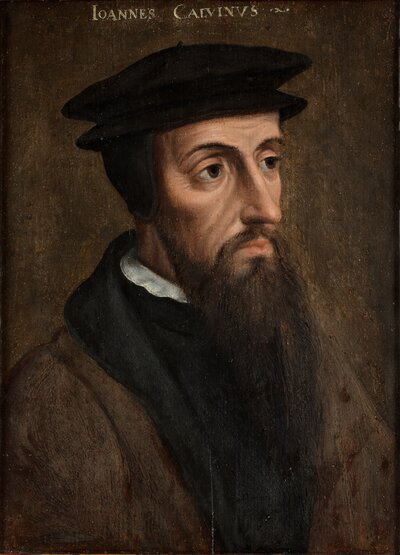
John Calvin
French-born Reformer, pastor, and theologian whose systematic exposition of Scripture in the Institutes and his biblical commentaries made him the most influential theologian of the Protestant Reformation.
Key Works
Institutes of the Christian Religion(1536/1559)
The definitive systematic theology of the Reformation, growing from a short catechism to a comprehensive guide to the Christian faith organized around the knowledge of God and the knowledge of ourselves.
Commentary on Romans(1540)
His first and perhaps finest biblical commentary, setting a new standard for careful, verse-by-verse exposition rooted in the original languages.
Commentary on the Psalms(1557)
A deeply personal commentary in which Calvin called the Psalms 'an anatomy of all the parts of the soul.'
Commentary on Genesis(1554)
A foundational commentary on the first book of the Bible, addressing creation, covenant, and the beginnings of God's redemptive plan.
John Calvin was the most systematic biblical thinker the Protestant Reformation produced. While Martin Luther lit the spark, it was Calvin who organized the fire — building a comprehensive theology from Scripture that has shaped Reformed, Presbyterian, and evangelical Christianity ever since. His Institutes of the Christian Religion and his commentaries on nearly every book of the Bible represent one of the most remarkable intellectual achievements in the history of the church.
His Story
Calvin was born in Noyon, France, and trained as a lawyer before experiencing what he described as a "sudden conversion" in which God "subdued and brought my mind to a teachable frame." Forced to flee Catholic France because of his Protestant convictions, he settled in Geneva, Switzerland, where — apart from a brief exile — he spent the rest of his life as pastor and theologian.
Geneva under Calvin became a center of the Reformation, attracting Protestant refugees from across Europe. Calvin preached almost daily, wrote commentaries and theological works at an astonishing pace, and trained a generation of pastors who carried Reformed theology throughout the continent and eventually to the New World. John Knox, the Scottish Reformer, called Geneva under Calvin "the most perfect school of Christ since the days of the apostles."
His Contribution to the Big Picture of Scripture
Calvin's overarching conviction was that all of life must be brought under the authority of Scripture. His Institutes are not a set of abstract doctrines imposed on the Bible but an attempt to let the Bible speak on its own terms. He wrote: "Our wisdom, in so far as it ought to be deemed true and solid wisdom, consists almost entirely of two parts: the knowledge of God and of ourselves."
His commentaries remain models of careful exegesis — attending to grammar, historical context, and the flow of the biblical author's argument. Calvin opposed both rigid literalism and fanciful allegory, insisting instead on what he called the "natural sense" of Scripture. He wrote in his commentary on the Psalms: "I have felt that the Psalms present an anatomy of all the parts of the soul, for there is not an emotion of which anyone can be conscious that is not here represented as in a mirror."
Calvin saw the whole Bible as revealing one covenant of grace, progressively unfolding from Genesis to Revelation. He traced how the Old Testament ceremonies, laws, and promises all pointed forward to Christ: "The covenant made with all the patriarchs is so much like ours in substance and reality that the two are actually one and the same. Yet they differ in the mode of dispensation."
Why Read Calvin Today?
Calvin is sometimes caricatured as cold and severe, but his actual writing is warm, pastoral, and deeply devotional. His commentaries are still consulted by scholars and pastors across the theological spectrum. His Institutes remain the most important systematic theology of the Reformation and one of the most influential Christian books ever written. For anyone who wants to understand how the whole Bible holds together theologically — how God's sovereignty, human responsibility, grace, and covenant weave through every page — Calvin is an indispensable guide. As he wrote, "There is not one blade of grass, there is no color in this world that is not intended to make us rejoice."