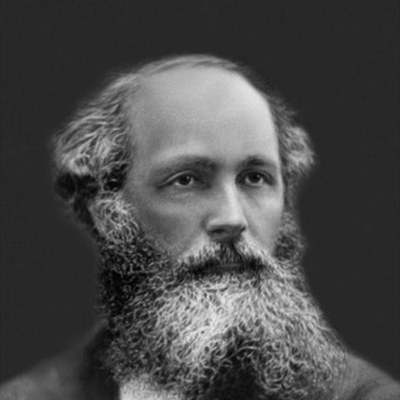
James Clerk Maxwell
Scottish physicist whose equations unified electricity, magnetism, and light, ranked alongside Newton and Einstein — and a devout Presbyterian whose handwritten prayers still survive.
Key Works
A Treatise on Electricity and Magnetism(1873)
His masterwork, setting out the complete mathematical theory of electromagnetism that underlies radio, light, and all of modern electrical technology.
On Physical Lines of Force(1861-1862)
The series of papers in which he developed his field equations and showed that light itself is an electromagnetic wave.
James Clerk Maxwell was the Scottish physicist who discovered that electricity, magnetism, and light are all one thing — different faces of the electromagnetic field. Physicists routinely rank him with Newton and Einstein, and Einstein himself kept Maxwell's portrait on his study wall. Maxwell was also a deeply committed evangelical Presbyterian whose handwritten prayers survive among his papers.
His Story
Maxwell grew up on a country estate in southwest Scotland, an endlessly curious boy who wanted to know "what's the go o' that?" about everything he saw. He lost his mother to cancer when he was eight. Educated in Edinburgh and at Cambridge, he went on to hold professorships in Aberdeen, London, and finally Cambridge, where he became the founding director of the Cavendish Laboratory.
His scientific range was astonishing. He explained the rings of Saturn, helped found the kinetic theory of gases, and produced the world's first color photograph. But his crowning achievement was the set of equations — now simply called Maxwell's equations — that unified electricity and magnetism and revealed light as an electromagnetic wave, opening the door to radio, television, and wireless communication.
Maxwell's faith ran just as deep. He knew much of the Bible by heart, led daily prayers in his household, and wrote out his own prayers by hand. When the Cavendish Laboratory was built under his direction, Psalm 111:2 was carved in Latin over its doors: "Great are the works of the LORD, studied by all who delight in them." He died of cancer at just forty-eight, calm and trusting in Christ to the end.
His Legacy
Maxwell's work quietly underpins the modern world:
- His equations remain the foundation of electromagnetism and led directly to radio, radar, and wireless technology
- His prediction that light is an electromagnetic wave was one of the great unifications in the history of science
- The Cavendish Laboratory he founded went on to host dozens of Nobel Prize-winning discoveries
- His example — and the Psalm over the Cavendish doors — has encouraged generations of believing scientists
Why Read Maxwell Today?
Maxwell saw scientific research as a form of delighting in the works of God, exactly as Psalm 111:2 describes. He pursued truth in the laboratory with total rigor and trusted Scripture with equal seriousness, and felt no need to play one against the other. For anyone who suspects that the deepest science and the deepest faith might belong together, Maxwell is one of history's best witnesses.