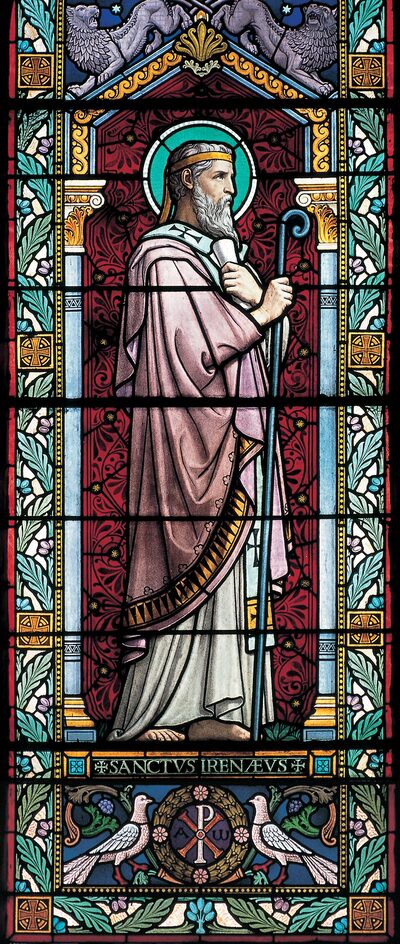
Irenaeus of Lyon
Bishop of Lyon and the first great theologian to articulate the Bible's unified story of salvation — from creation through incarnation to final restoration — against heretical distortions of Scripture.
Key Works
Against Heresies(c.180 AD)
A comprehensive refutation of Gnostic teachings and a landmark articulation of the Christian faith grounded in the whole narrative of Scripture from Genesis to Revelation.
Demonstration of the Apostolic Preaching(c.190 AD)
A concise summary of the Christian faith as taught by the apostles, tracing the biblical story from creation to Christ.
Irenaeus of Lyon was the first Christian theologian to articulate a comprehensive theology of salvation history — the idea that the Bible tells one continuous story from creation to new creation, with Christ at its center. Writing in the second century, just a few generations removed from the apostles themselves, Irenaeus defended the faith against Gnostic distortions and laid foundations that the entire Christian tradition has built upon ever since.
His Story
Irenaeus was born in Smyrna (modern-day Izmir, Turkey), where as a boy he sat at the feet of Polycarp, who had himself been a disciple of the Apostle John. This living chain of witness — from John to Polycarp to Irenaeus — gave him a deep sense of connection to the apostolic faith and a fierce determination to preserve it faithfully.
He eventually settled in Lyon, in what is now southern France, where he became bishop around 177 AD. His community had endured severe persecution, and Irenaeus understood that correct teaching was not an academic luxury but a matter of spiritual life and death. When Gnostic teachers began spreading a radically different version of Christianity — one that rejected the Old Testament, despised the material world, and claimed secret knowledge — Irenaeus responded with the most important theological work of the second century: Against Heresies.
His Contribution to the Big Picture of Scripture
Irenaeus's great theological contribution was what he called the "economy" (oikonomia) of salvation — God's unified plan unfolding through history. Against the Gnostics, who pitted the God of the Old Testament against the God of the New, Irenaeus insisted that there is one God, one creation, one story, and one plan of salvation. He wrote: "There is one God, who by His Word and Wisdom created and arranged all things."
His vision of salvation history centered on what he called "recapitulation" — the idea that Christ, the second Adam, relived and redeemed every stage of human existence. As he wrote, "He became what we are so that He might bring us to be what He is." This is one of the earliest and most powerful formulations of the gospel in the history of Christian thought.
Irenaeus also insisted that the material creation is good — made by a good God, corrupted by sin, and destined for restoration, not destruction. He wrote: "The glory of God is a human being fully alive, and the life of a human being is the vision of God." This vision of creation, fall, redemption, and final glorification anticipated by centuries the narrative theology that modern scholars like N.T. Wright would develop.
Why Read Irenaeus Today?
Irenaeus is the earliest theologian to read the entire Bible as one unified story of God's salvation. His writings are a powerful antidote to any tendency to fragment the Bible into disconnected pieces or to pit the Old Testament against the New. His emphasis on the goodness of creation, the reality of the incarnation, and the hope of bodily resurrection feels remarkably fresh in an age that often spiritualizes the faith beyond recognition. Reading Irenaeus connects you to the earliest generations of Christians and reminds you that the big-picture reading of Scripture is not a modern invention — it goes back to the very beginning of the church.