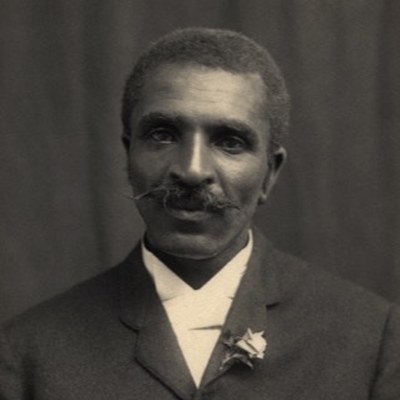
George Washington Carver
Born enslaved, he became the most famous Black scientist of his era — an agricultural chemist at Tuskegee who served poor farmers and spoke openly of God revealing the secrets of creation.
Key Works
How to Grow the Peanut and 105 Ways of Preparing It for Human Consumption(1916)
His most famous Tuskegee bulletin, written to help poor Southern farmers turn a soil-restoring crop into food and income.
Tuskegee Agricultural Bulletins(1898-1943)
Decades of free, practical bulletins on crops, soil, and nutrition, written in plain language for farmers with little money and less schooling.
George Washington Carver was born enslaved in Missouri near the end of the Civil War and became the most famous Black scientist of his generation. From his laboratory at Tuskegee Institute — which he called "God's Little Workshop" — he spent nearly half a century helping poor Southern farmers, and he never tired of saying that everything he discovered, God had revealed.
His Story
Carver's early life was marked by hardship: orphaned as an infant, frail in health, and turned away from schools because of his race. He worked his way through Iowa State Agricultural College, earning a master's degree and becoming its first Black faculty member, before Booker T. Washington invited him to Tuskegee Institute in Alabama in 1896. He stayed for forty-seven years.
The South's soil was exhausted by endless cotton planting, and its small farmers — many of them Black sharecroppers — were trapped in poverty. Carver taught crop rotation with peanuts and sweet potatoes to restore the soil, then developed hundreds of products from those crops so farmers could sell what they grew. He took his teaching directly to the people with a mobile classroom wagon, and his fame eventually reached Congress, where his 1921 testimony on the peanut made him a national figure.
His faith was as public as his science. He rose before dawn to walk in the woods and pray, saying that was where he heard God best. For decades he taught a voluntary Sunday evening Bible class at Tuskegee that students packed out year after year. He spoke constantly, and without embarrassment, of God as the source of his ideas.
His Legacy
Carver's life joined science, service, and faith in a way few have matched:
- His crop rotation teaching helped renew Southern agriculture and lift farmers out of dependence on cotton
- His hundreds of peanut and sweet-potato products showed the creative potential hidden in humble crops
- He chose to spend his career serving the poor rather than chasing wealth, turning down lucrative offers to stay at Tuskegee
- His openness about prayer and the Bible made him one of the most visible Christian scientists of his time
Why Read About Carver Today?
Carver overcame slavery, prejudice, and poverty without bitterness, and used world-class talent in the service of the world's overlooked people. His science was an act of love for his neighbors, and his laboratory was a place of prayer. For anyone wondering what it looks like to do ordinary work as worship — and to treat creation as a book God is willing to open to the patient and humble — Carver's life is one of the best answers America has produced.