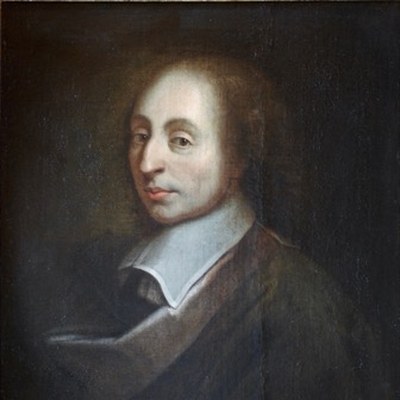
Blaise Pascal
French mathematician, physicist, and inventor whose dramatic conversion in 1654 produced some of the most penetrating Christian writing ever set down, gathered after his death as the Pensées.
Key Works
Pensées(1670)
His unfinished notes for a defense of the Christian faith, published after his death — fragments of startling insight into God, doubt, and the human heart.
Provincial Letters(1656–57)
A series of witty, devastating letters on grace and moral seriousness in the church, still regarded as a masterpiece of French prose.
The Memorial(1654)
The scrap of parchment recording his 'night of fire' — an overwhelming encounter with 'the God of Abraham, Isaac, and Jacob' — which he sewed into his coat and carried until he died.
Blaise Pascal was one of the great geniuses of the seventeenth century — a pioneer of probability theory, a physicist who gave his name to Pascal's law, and the inventor of one of the first mechanical calculators. Yet he is remembered above all for what happened on a single night in 1654, when the God of the Bible became overwhelmingly real to him and redirected the rest of his short life.
His Story
Pascal was born in Clermont-Ferrand, France, and educated at home by his father. He was a prodigy: as a teenager he was producing original work in geometry, and in his early twenties he built a calculating machine to help his father, a tax official. His experiments on air pressure and the vacuum, and his correspondence with Fermat that helped found the mathematics of probability, made him famous across Europe.
Then, on the night of November 23, 1654, Pascal had an intense experience of God that he could only call "fire." He scribbled down what he felt — "God of Abraham, God of Isaac, God of Jacob, not of the philosophers and scholars... Certainty. Certainty. Feeling. Joy. Peace." — and sewed the parchment into the lining of his coat, where it was found only after his death. From then on he devoted himself chiefly to Christ, defending serious faith in his Provincial Letters and gathering notes for a great defense of Christianity. He died at thirty-nine, leaving those fragments behind as the Pensées.
His Legacy
Pascal's brief life left a remarkable double inheritance:
- His mathematics and physics helped lay foundations for probability theory, fluid mechanics, and computing
- The Pensées remains one of the most quoted and influential works of Christian thought ever written
- His famous "wager" challenged skeptics to take the question of God with total seriousness
- He showed that brilliant science and wholehearted Christian faith can live in the same mind
Why Read Pascal Today?
No one has written more sharply about the restlessness of the human heart — our boredom, our distractions, our greatness and wretchedness — or pointed more clearly to Christ as the answer. "The heart has its reasons, which reason does not know," he wrote, insisting that faith engages the whole person. For modern readers juggling doubt and longing, Pascal feels less like a voice from the 1600s and more like a contemporary.